One shared, permission-aware, auditable AI memory for an entire organization. Every employee’s agent reads and writes the same institutional knowledge, over whatever surface they already work in, under one compaction and degradation-avoidance discipline. org-memory-os is a vendor-neutral blueprint you paste into any coding agent, and it builds the system with you, stopping to ask at every decision your cloud, your identity provider, and your regulator would answer differently.
Read the build guide · The personal sibling: RAG-OS · GitHub repository
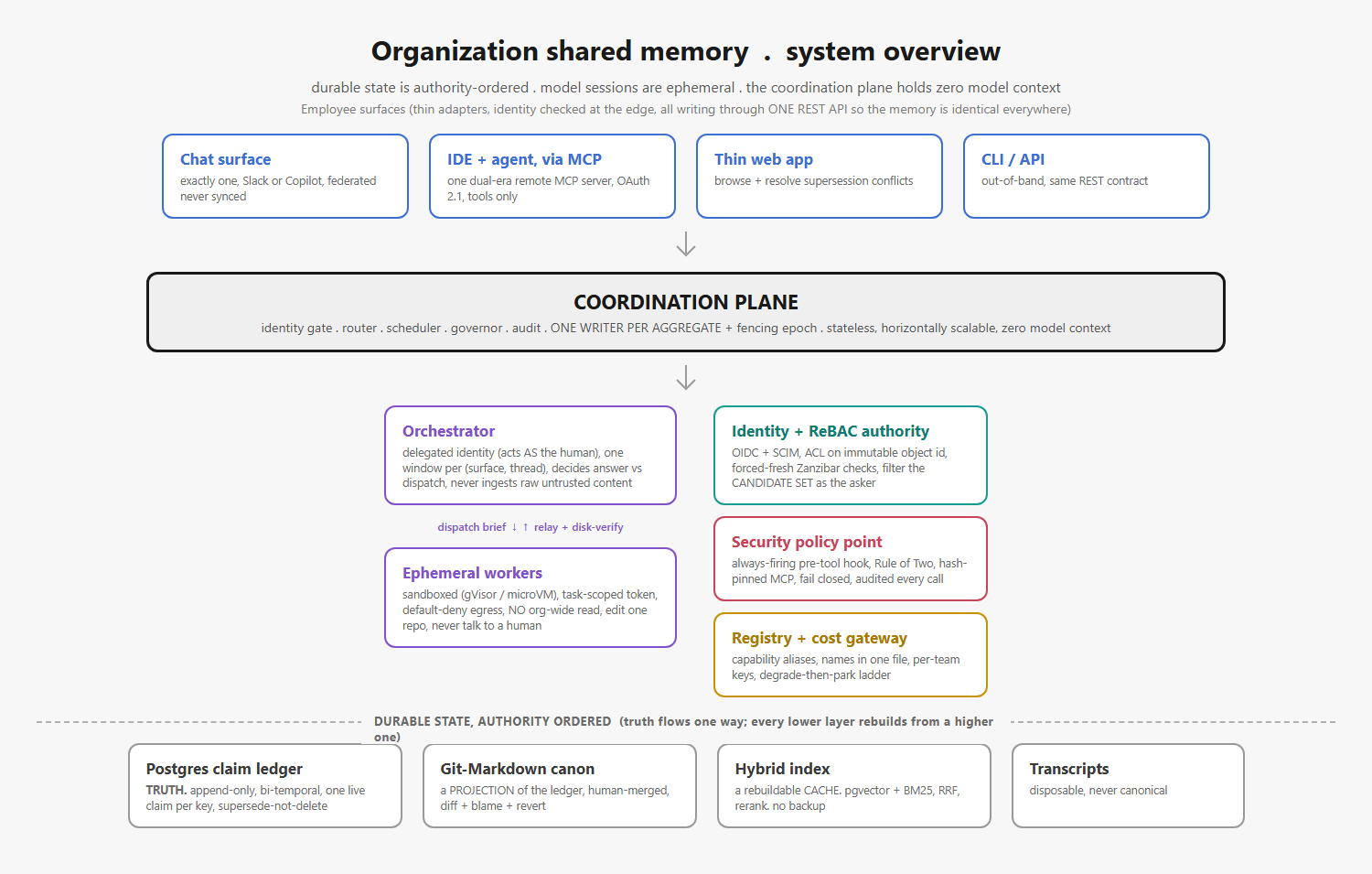
The question it answers
A personal AI agent that remembers what it learned last week is a solved shape. The hard question shows up the moment more than one person is involved: how do two hundred people, and their two hundred agents, share one memory without leaking it, poisoning it, letting it rot, or losing the thread? That is not RAG with more machines. It breaks the specific invariants that make a single-user design simple, and each break has a right answer that is expensive to discover and cheap to copy.
What it is
Not a framework to install. A compiled architecture: thirteen pillars, seventy decision forks each with a recommended default and its alternatives, thirty-eight failure modes to design against (five carried from the personal system, thirty-three new at org scale), and a sixteen-milestone build order where every step is proven with a real command and its real output before it counts as done. The founding rule is that durable state lives in files and a database whose authority is explicitly ordered, the model sessions are ephemeral, and the coordinating layer holds zero model context. At org scale the database is no longer one file with one writer, the operator is no longer one trusted person, and the blast radius is no longer one laptop, and the whole guide is the disciplined consequence.
What breaks when a personal system becomes an organizational one
- One process is the only writer becomes one writer per aggregate, enforced by the database, with a fencing token.
- Identity as a boolean becomes an identity graph, checked freshly on the candidate set as the asking human, never on the generated answer.
- The operator reviewing every ingest becomes tiered trust by source with a human merge as the boundary into canon.
- Invalidate-never-delete stays correct for knowledge and becomes wrong for personal data, which must be erasable against GDPR while git history is immutable.
- Two things are entirely new: a legal retention-and-erasure machine, and, for regulated orgs, model-risk governance that forbids one team from both building and validating the system.
What you get
- A coordination plane of stateless coordinators that hold zero model context, with a fencing epoch instead of one process owning a file.
- An authority ladder: an append-only Postgres claim ledger is truth, git-Markdown is a projection of it, the hybrid index is a rebuildable cache, transcripts are disposable.
- Identity and authorization done freshly: OIDC and SCIM, ACLs on the immutable object ID, ReBAC with forced-fresh reads, permission filtering on the candidate set.
- A compaction and degradation-avoidance discipline: kernel-owned windows scoped per surface and thread, three-zone prompt caching, and a nightly measured degradation eval.
- A governance layer no personal system needs: four retention classes, per-subject crypto-shredding, legal hold, and an immutable WORM audit tier with citation-level forensics.
How it compares
The individual ideas are not new, and the guide says so. Git-backed Markdown agent memory shipped as a product in early 2026, and more than one commercial system proves the shape is not exotic. The value is the org-scale discipline that makes it survive a security and compliance sign-off, and owning every byte.
| System | What it is | How org-memory-os relates |
|---|---|---|
| Glean | Permissions-aware enterprise search | Rent it for connectors and identity resolution; it has no git-blame provenance or supersede semantics. |
| Dust | MIT-licensed, self-hostable agent platform | The closest commercial analogue and proof the shape is not exotic; this is the owned, supersede-native version. |
| Microsoft 365 Copilot | Graph-grounded assistant | Wins if your knowledge already lives in one Microsoft estate; it does not compile authored decisions. |
| Letta / Zep / mem0 | Agent memory runtimes | Per-agent or per-user memory; this is org-shared memory with ReBAC authority and a retention machine. |
| Amazon Q Business / Kendra | Managed enterprise RAG | The guide’s cautionary tale: both closed to new customers in 2026. Plain Markdown in git is the hedge. |
Get started
Open BUILD-GUIDE.md, confirm the six preconditions, then paste it into your coding agent and say: “Help us build this. Follow the agent protocol at the top.” It asks at every fork, so the result matches your cloud, your budget, and your regulatory exposure. A defensible pilot for one team lands at Milestone 9; company-wide needs through Milestone 14.
If org-memory-os is useful to you, a star helps other people find it.